Previs Director Mohammad Khalikh details the role of iClone in visualizing Amazon Prime India’s “The Forgotten Army”
befores & afters journalist Ian Failes interviewed Mohammad on how he took advantage of Reallusion’s iClone and Character Creator to deliver the previs for The Forgotten Army – Azaadi ke Liye. This highly watched production garnered 23 million views on its YouTube trailer
Khalikh worked for Pre-Production Company, founded by Kamal Sadanah, on the previs for The Forgotten Army. Supervisor Gigi George worked closely with a team of four artists – Shilpa Hegde, Manpreet Singh, Philip Verghese and Khalikh. Each artist concentrated on specific shots in the series.
The workflow began with asset creation. Khalikh started by generating characters with a low-poly character from Makehuman, converting them into objects with multiple perform animations which were made into hundreds of soldiers attacking the Indian army.
“Now with the new features in Character Creator, it is easier to make low-poly models using the LOD feature.”
Mohammad Khalikh
Character Creator digital actors in the previs.
Khalikh has been an iClone user for three years and he found it extremely well-suited for movie previs due to its ease of use and fast rendering time.
“When it comes to previs, we don’t require final animation: so iClone is the best software for because of its real-time renders and the use of motion-captured files.”
In this 4 part series for – Master Class “Fast Cartoon Design” Luis Duarte shares his tips and tricks on how to take advantage of Character Creatorand iCloneto create a cartoon character and animate his face and body easily. This 4 part series will cover the entire of process with Character Creator, ZBrush, Substance Painter, and iClone.
In this 4 part series for – Master Class “Fast Cartoon Design” Luis Duarte shares his tips and tricks on how to take advantage of Character Creatorand iCloneto create a cartoon character and animate his face and body easily. This 4 part series will cover the entire of process with Character Creator, ZBrush, Substance Painter, and iClone.
In this 4 part series for – Master Class “Fast Cartoon Design” Luis Duarte shares his tips and tricks on how to take advantage of Character Creatorand iCloneto create a cartoon character and animate his face and body easily. This 4 part series will cover the entire of process with Character Creator, ZBrush, Substance Painter, and iClone.
Steve Cavalcanti is a Brazilian artist living in the United Kingdom for the past 20 years.
With a background in photography and traditional illustration, Steve created Tivo Studios four years ago, using his skills to create adult animations for a great diversify of topics like musical videos, intros, funny sketches, parodies and social commentary.
Hello my name is Luis Duarte and I am a 3D instructor on LibelStudio.com. From a young age I studied fine arts, and it’s a hobby that I’ve always loved. When I finished my technical career in Graphic Design, I decided to go a little further, and I discovered all the learning possibilities that I had in front of me, that’s how I met 3D design. A few years have passed since then, but I feel like it’s just beginning.
Until today, I have had the opportunity to work on many modeling, character design, concept art, Hard Surface projects, and I feel that each thing has given me great knowledge to continue contributing to this great industry of digital content development, especially now with the new advents in character design. Character design is now more efficient thanks to iCloneand CharacterCreator.
We all know that generating a portfolio character involves a process that is not necessarily short. Working with modeling in its different applications, texturing, rigging and rendering, implies a time if what you are looking for is a clean and pleasant job. However, specialized tools such as Character Creator make it possible to shorten development times by almost 35%. Taking advantage of its automatic rigging system, we can start from a base avatar that can be deformed countless times, which we can update with poses and facial gestures in real time from the first creation stroke.
“Specialized tools such as Character Creator make it possible to shorten development times by almost 35%. And best of all, it doesn’t affect my original workflow.”
Luis Duarte – 3D Artist
And best of all, it doesn’t affect my original workflow; that is, I can sculpt the model in ZBrush, or even add accessories in Blender or 3ds Max, thanks to its compatibility with other programs. However, if the purpose is to animate the character, then we can bring it to iClone and generate beautiful, very professional animations in just a few clicks. In this tutorial I will teach you the process of creating a cartoon style character using this fabulous working method.
Reallusion Releases 2D Motion LIVE for Cartoon Animator
Reallusion announces the release of Cartoon Animator 4.2 and 2D Motion LIVE, the first complete 2D animation system for live performance and motion capture. 2D Motion Live, a new plugin for Cartoon Animator is a unique 2D mocap solution that connects industry-leading motion capture devices to control characters and puppets inside Cartoon Animator for a total face, body and hand solution. 2D Motion Live brings characters to the stage as live performances with a fast production workflow for character setup, motion capture and editing.
Abhi has always been driven by the desire to create cutting edge visual stories. He has experience writing for the stage and television and has also written and directed multiple short films. After trying his first virtual reality experience Abhi dedicated himself to creating VR content that would instil the same feeling of awe and wonder in audiences that he felt when he first tried VR. His latest project is The PhoenIX.
The PhoenIX is a CG cutting edge VR series with a complex narrative, truly cinematic 360 directing and innovative storytelling methods that fully leverage the medium of narrative VR. Like all good science fiction it not only entertains but holds up a mirror to society and asks deeper questions such as who we are as a race and where are we headed. Ultimately, the series is about unity, about how we need to come together to survive rather than stand apart.
The small and passionate team at Warrior9 VR created the series in VR, where they employed tools like Character Creator 3, iClone, Perception Neuron and Unreal Engine to not only provide the most visceral experience audiences could ever have but to also showcase the narrative potential of this brand new medium. This is science fiction like you have never seen before.
“With a team of 6 we were able to create high quality animated VR content and part of this is thanks to tools like Character Creator. “
Abhi Kumar – Creative Director / Warrior9 VR
Q: Hello Abhi and the Warrior9 VR team! Kindly tell us more about your VR project The PhoenIX.
Hello! The PhoenIX is essentially a sci-fi animated series in stereoscopic 360 but to us, it is so much more. Our small and passionate team at Warrior9 VR wanted to create something unique and mind-blowing so we worked hard to push the boundaries of 360 storytelling and take users on the most visceral journey of their lives through this epic sci-fi saga.
Warrior9 Team
The story follows the day-to-day lives of a group of warriors in the distant future, called The PhoenIX, who are ambushed by an unknown enemy and suddenly find the fate of humanity in their hands. In order to survive, they must come together and fight. Ultimately, it’s a show about unity, about how we need to come together to overcome our problems. This is science fiction like you have never seen before.
The PhoenIX – Trailer
Q: The PhoenIX reminisces on so many of the sci-fi films and series we all loved. Please tell us a little on how you got the inspiration for all of this, and what motivated you to make this a VR experience.
I have always loved science fiction. It’s a genre which is only restrained by your imagination – in sci-fi anything is possible. Growing up I would consume it in any form I could – TV, movies, video games, comics, anything. So that’s why when you watch The PhoenIX you’ll see things that trigger memories of 2001: A Space Odyssey, Blade Runner, Tron and so on. I took my favorite influences and have incorporated them into this series.
As to why we chose to do this series in VR, it happened pretty much right after I first tried the Oculus DK2 back in 2015. I thought sci-fi would be PERFECT for a medium like VR. When I was growing up, virtual reality was considered to be science fiction so it made perfect sense to pair the two together and just let our imagination run wild!
Q: For this project you utilized Character Creator 3, along with Perception Neuron motion capture suits with iClone and Unreal Engine. Tell us why you chose to adopt these tools, and what benefits/advantages you find in them?
The Warrior9 VR team is quite small and so we really needed a way to efficiently create good quality character models and animation on a limited budget. We didn’t have strong 3D character modeling skills internally at the start so we thought we could outsource this part. Ultimately we weren’t happy with the quality and we couldn’t justify the cost of it so we started looking at alternatives.
Avatars made with Character Creator 3
“That’s when we came across Character Creator and it was perfect to get us started. It allowed us to, very quickly, create unique and exciting looking characters for our series.”
Abhi Kumar – Creative Director / Warrior9 VR
We also found that iClone had a plugin for the Perception Neuron mocap suits and decided to go ahead and use that functionality as well since it allowed us to see the characters in the modelled environments as we did the mocap and help the overall animation process.
As a small studio, we needed these kinds of tools to help us get started and really ignite the production process. Let’s be honest, nothing is perfect, it’s not like we didn’t have to troubleshoot or overcome any technical issues, but in the end, with a team of 6 we were able to create high quality animated VR content and part of this is thanks to tools like Character Creator.
Q: The PhoenIX is available on multiple headsets. Where can viewers experience this series? And what future projects can fans look forward to from the Warrior9 VR team?
We completed Season 1 of The PhoenIX, comprised of 6 episodes, in early 2020. We’re currently working on getting the full series out to people but if you have access to Amaze VR or VeeR apps on your VR headsets then you can see the first half of the series today. You can also check out our dedicated website and Facebook or follow Warrior9 VR on Instagram to keep up to date on releases.
At Warrior9 VR we work on narrative immersive experiences that have a deeper meaning or impact while still being entertaining and telling a good story. The PhoenIX, for example, is about unity. We want to start work on Season 2 (it’s scripted and ready!) but we do have a number of other experiences that we are releasing.
The tragedy of plastic pollution in our oceans is pretty important to us as we are scuba divers as well. We have created a number of interactive experiences on this topic:
Our Ocean Life is an augmented reality portal experience available on iOS and Android stores.
Oceans We Make is an interactive VR experience available on Steam and Oculus stores.
We’re looking to continue creating exciting narrative immersive experiences in the near future.
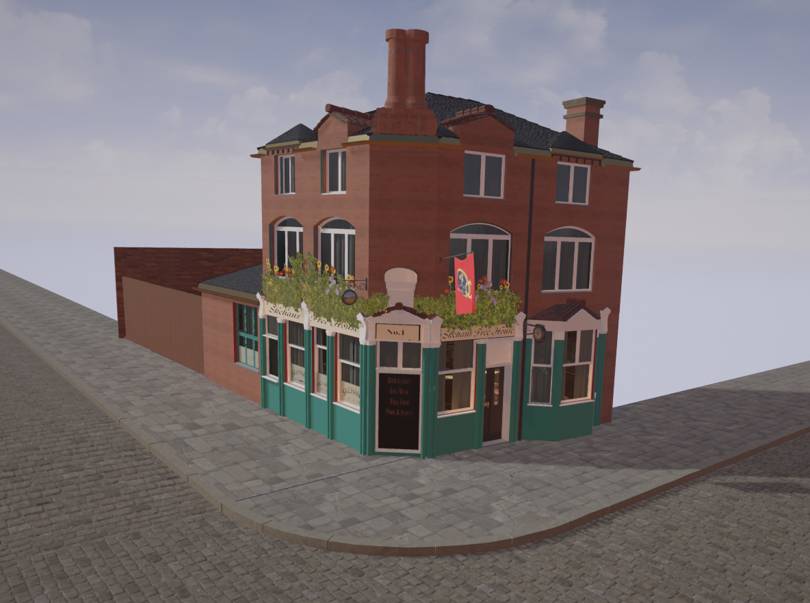
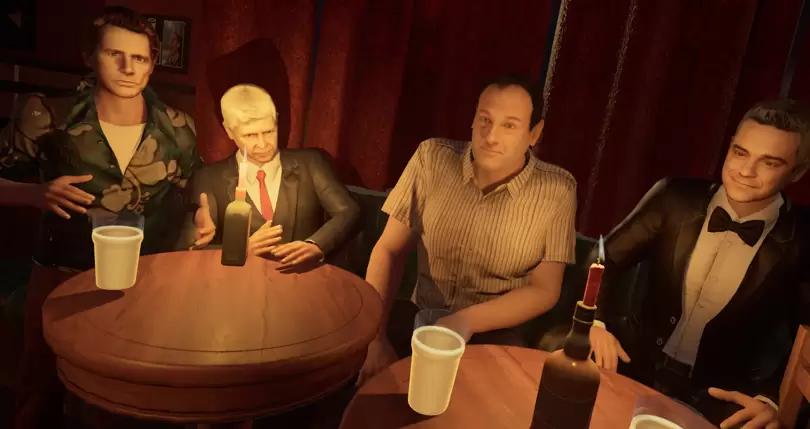
Wired Magazine recently published a story where writer, Tristan Cross explored how he could recreate his local pub in VR to break away from the confines of quarantine. The big challenge was to create 3D characters for his VR project that resembled his friends in order to create a virtual evening out at the pub together. Here is a brief recap of the article. For the full article: https://www.wired.co.uk/article/i-made-my-local-pub-in-vr
The journey into reproducing Tristan’s local London pub – SKEHAN’S, begins with a discussion about the nature of social experiences in virtual reality and goes directly into the creation of the 3D model using Blender. Tristan’s 3D model of Skehan’s is generated using blueprints provided by the owner of the bar. The project was developed for Unreal Engine and makes use of the Quixel Megascan library for the texturing of Skehans.